
Product Stewardship Strategy


| Stakeholder | Type of Impact | Cause of Impact |
|---|---|---|
|
Shareholders
|
Supply Chain, Operations | |
|
Business Partner
|
Supply Chain, Operations | |
|
Customer
|
Products/Services | |
|
Investor
|
Operations | |
|
Community
|
Supply Chain, Operations | |
|
Public Sector
|
Products/Services | |
|
Employee
|
Products/Services, Operations |
SDGs Targets


| Long-Term Targets | Targets in 2025 | Progress in 2025 | |
|---|---|---|---|
| Sustainable Product | Increase sustainable product revenue share to 20-30% by 2030 | - | Increased sustainable product revenue share to 21%* |
* The performance results mentioned are from operations in 2024. The 2025 performance results will be collected and updated by April 2026.
Business Case, Business Impact: Risk/ Cost / Revenue
Why business must focus on Sustainable Product Management
Sustainable product management does not only play an essential part in complying with legal requirements and reducing environmental and ecological impacts, but also responds to consumer and customer expectations, creates competitiveness and long-term business growth, and reduces future production costs, leading to GC’s leadership in the petrochemical industry.

Reduce Environmental Impacts |
Integrate circular economy principles in business operations to cope with resource constraints and environmental concerns through the efficient use of resources, reducing the quantity of landfill waste as well as impacts throughout the product life cycle. |
|---|---|

Promote Consumer Health and Safety |
Design and develop safe products, reduce the use of hazardous substances in response to consumer health concerns, reducing health risks for Consumer. |

Increase Competitiveness and Generate Long-term Income |
Develop new products and innovations to meet rapidly changing market demands, thus elevating competitiveness and increasing business growth opportunities in the long run. |

Reduce Costs and Expenses |
Reduce the use of fossil-based raw materials and fuels and increase renewable and recycled material utilization due to challenges regarding raw material sourcing and stricter standards, resulting in enhanced sustainability and decreased risk from finite resource depletion. |
Management Approach GRI 3-3 (2021)
Challenges and Opportunities
Petroleum, petrochemical, and chemical products have become the basic necessities of living while creating benefits for the country in terms of basic products and key export products which generate country’s income. However, the problem of plastic waste has become a global concern, which requires the joint efforts of the international community to find a solution, e.g. campaigning to reduce, refrain from, and stop using plastic bags and single-use plastic, etc.
Taking this issue into account, GC is committed to develop sustainable product portfolio management to ensure compliance with legal requirements and to integrate the principles of the circular economy into its business operations. This approach aims to minimize environmental and ecological impacts while responding to the expectations of consumers and customers. By doing so, the company enhances its competitiveness, supports long-term business growth, and reduces future production costs, ultimately paving the way toward industry leadership in the petrochemical sector.
Product Stewardship Management Process

To fulfill GC’s commitment to reducing environmental impacts across the value chain, as well as to enhance competitiveness and capture growth opportunities in environmentally friendly and health-related chemical products, the Company applies eco-design principles and environmentally friendly production processes. The Company has developed a Sustainable Product Management mechanism by establishing criteria to assess and classify its products across five key dimensions: greenhouse gas emissions, product circularity and design, sustainable raw materials, energy management, and hazardous materials and substances.
GC is dedicated to researching, developing, and promoting innovations that utilize natural raw materials and bio-based chemical alternatives sourced from verified and reliable suppliers, in order to create products that are safe for the environment and human health. This approach aims to generate business value that meets market and consumer needs while supporting long-term sustainable development.
Product Stewardship Policy
Product StewardshipHealth-and Environmental-Friendly Products
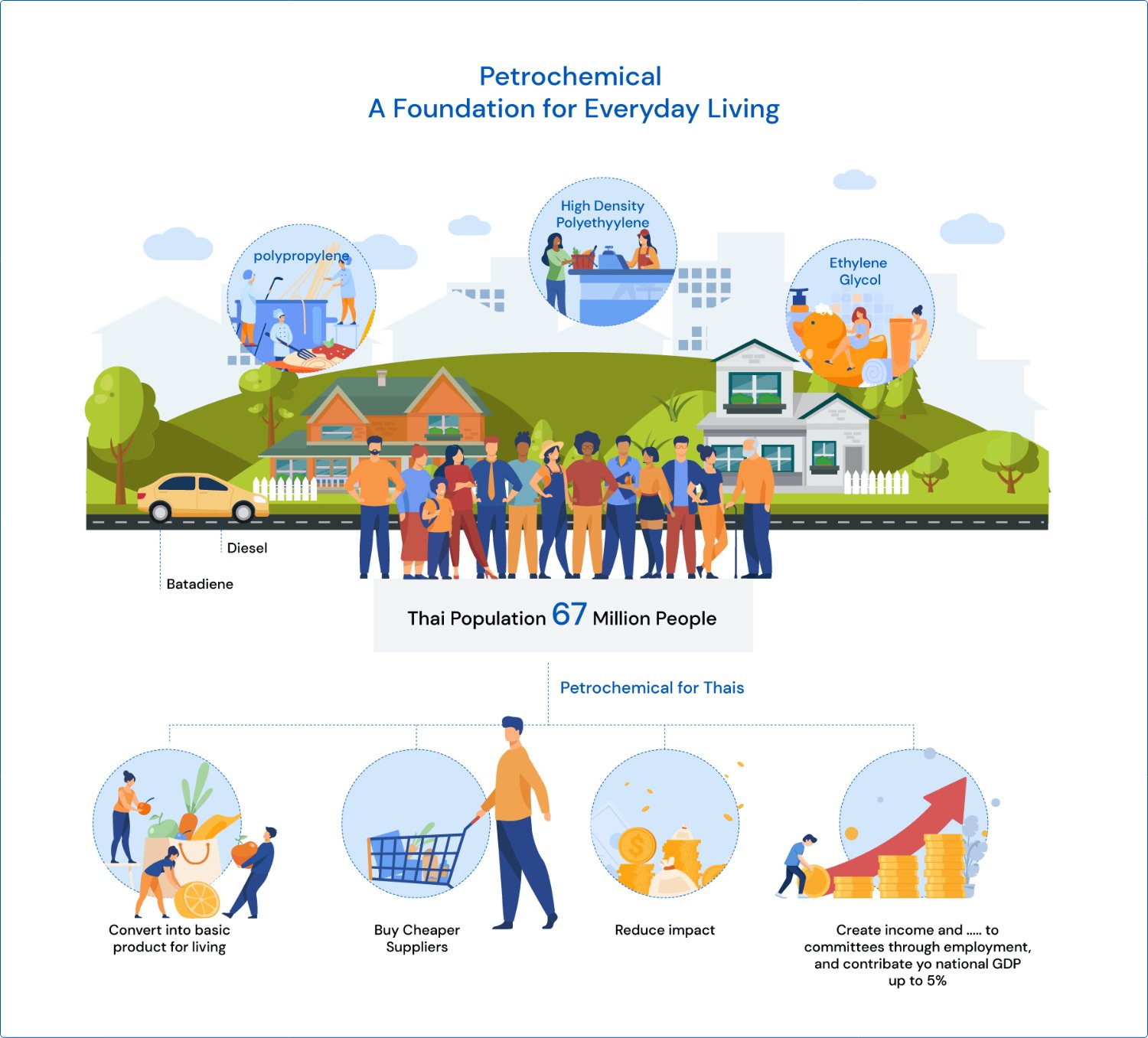
GC aims to develop petroleum, petrochemical, and chemical products for daily use to create a better living and respond to consumers’ needs, while at the same time, GC is also focusing on responsibility towards the environment and the society as well as create income for the country.
GC also recognizes its public responsibility regarding the use of Genetically Modified Organisms (GMOs) by clearly stating its position on the safety of its raw materials and products.
Responsible Care
GC prioritizes product stewardship by ensuring that its manufacturing processes throughout the supply chain are socially and environmentally responsible, minimizing negative impacts while maintaining a strong focus on safety. The company has adopted the Responsible Care® framework, a voluntary initiative developed by the International Council of Chemical Associations (ICCA). This global commitment by the petrochemical industry underscores the responsibility of companies to continuously improve performance in health, safety, and environmental protection—both in business operations and for the broader society.
GC remains dedicated to integrating the principles of Responsible Care® into its operations, contributing to global challenges by continuously enhancing environmental, health, and safety measures while improving the quality of life for all.